
By clicking “Accept,” you agree to the storage of cookies on your device to improve website navigation, analyze site usage, and support our marketing efforts. For more information, please see our Privacy Policy.

All Insights
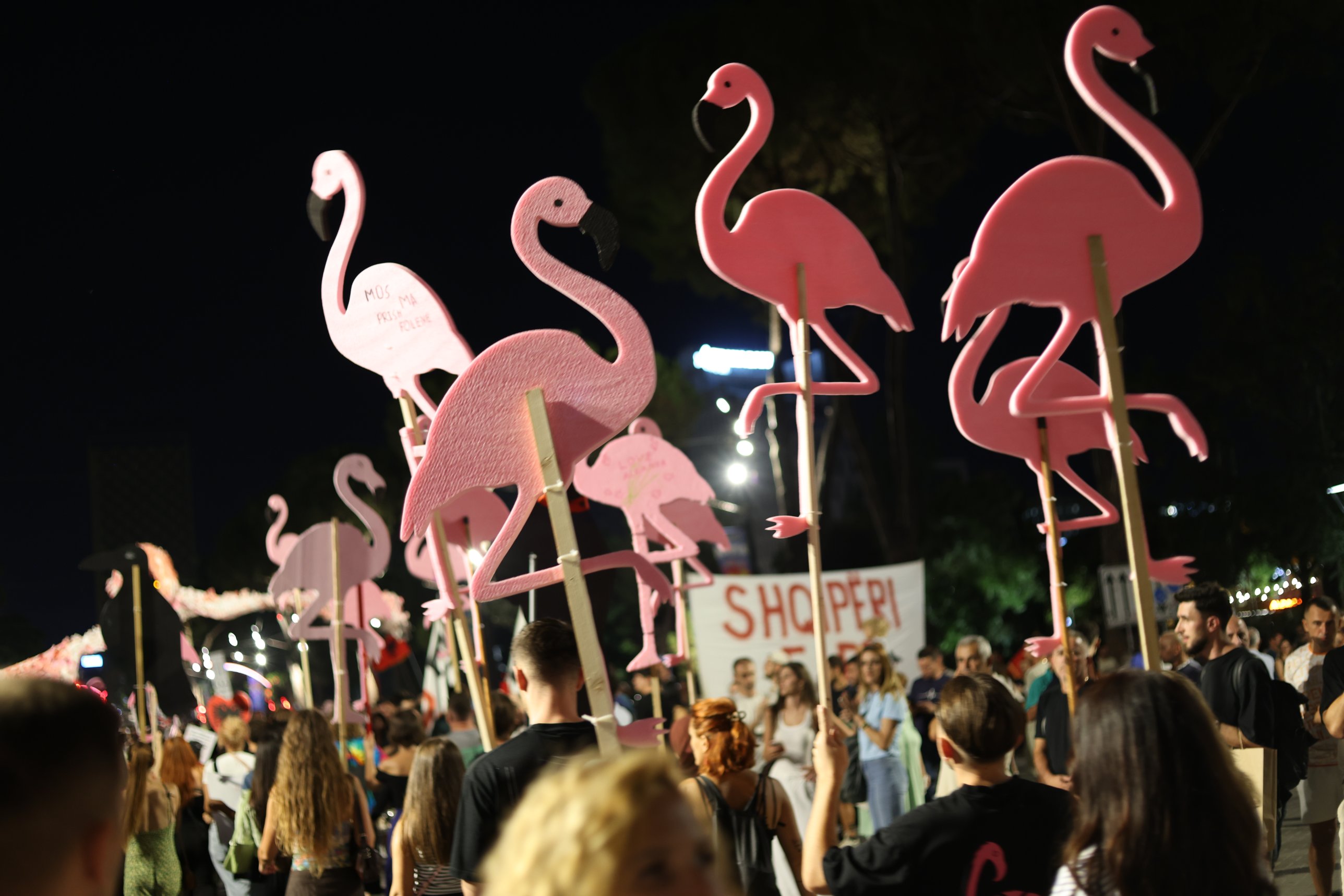
On 31 May, the first protest of the Flamingo Revolution took place in Tirana in defence of the Narta Lagoon and the Vjosa River, after local residents had been protesting for days in Zvërnec. They were protesting against the installation of fences and barbed wire in the area without their knowledge or consent. The fenced-off land lies within a protected area designated for a luxury tourism development.
I went to that first protest not only as a member of the Volt Europa Board, but also as someone who grew up in Albania, where protests are not a common occurrence. ‘Albania is not for sale’ became the movement’s slogan, while flamingos became its symbol. It is the largest civic movement in Albania in recent decades.
What began as an attempt to protect Narta and Vjosa quickly turned into a broader discussion about environmental protection, transparency, public participation and the type of development Albania wants to pursue. The Narta Lagoon and the Vjosa River form a natural area of particular importance, rich in rare species and migratory birds. The controversy has also been linked to plans for major tourism investments, including the project associated with Jared Kushner and Ivanka Trump. But the issue goes beyond the investment or the investors. How was the decision on the protected area taken, and on what environmental guarantees will these developments proceed?
The problem dates back further, to Law 21/2024 on protected areas. The law facilitates investment and development within protected natural areas, while its amendments have been criticised for their potential consequences for environmental protection, transparency and public participation. In this context, the law and the projects promoted for the development of protected areas became a catalyst for the mobilisation of hundreds of citizens.
The Flamingo Revolution thus became something more than a protest for a lagoon. It reflected a broader concern about how public decisions are made and about citizens’ trust in Albanian institutions. The protesters are not against investment, tourism or economic development. They are asking for transparency, opportunities to participate in decision-making and the protection of these areas. Law 21/2024 revealed not only a lack of transparency but also the malfunctioning of the structures that should guarantee democracy, and that raised further questions about the system and about the future of Albanian society.
Albania is an EU candidate country. The investment in a protected area, the changes to the relevant legislation and a protest that has now lasted three months therefore raise broader questions about how the EU approaches candidate countries and their integration process. This makes the issue one that deserves closer scrutiny by European institutions.
I have followed the protest in Tirana every day, reported on it and interviewed protesters about their reasons and their demands. I have spoken to local residents of the Narta Lagoon, citizens of Tirana, pensioners, young people and the diaspora, which has travelled several times to take part in the marches. Their answers have been the same: a review of Law 21/2024 on protected areas, transparency in decision-making, institutions that serve the people and the fight against corruption. One student told me: ‘The interference with protected areas and the lack of transparency was the spark that ignited our revolt against a system that has not served us for years.’
The protest has also drawn attention beyond Albania. Members of the European Parliament travelled to the country to visit the Narta Lagoon and to see the citizens’ protests for themselves. Their visit carried the issue from the streets of Tirana into the European institutions.
I am the first Albanian living in Albania to serve on the board of a pan-European movement. That position has given me a different perspective on this protest and on Albania, and above all on the role the European Union plays, and could play, in the Vjosa–Narta issue.
Albania's accession negotiations are conducted chapter by chapter, and Chapter 27 covers environment and climate change, an area in which Albania must meet the relevant EU standards and requirements. The issue of Narta and Vjosa is therefore not only an internal Albanian matter, but a concrete test of Albania’s ability to implement European environmental standards. Vjosa–Narta is not only a nationally protected area; it also has international significance, including candidate status in the Emerald Network and designation as an Important Bird Area (IBA).
It is in this context that the Flamingo Revolution takes on a European dimension. The movement highlighted not only the lack of transparency regarding protected areas, but also problems of accountability and corruption, of the justice institutions and of democracy itself. Albania does not lack laws and reforms aligned with European standards. The challenge lies in the mechanisms for their implementation, monitoring and enforcement, and this is precisely what the European Union should be looking at in relation to Albania.
In the case of Narta and Vjosa, the EU should require public consultation with citizens, accountability for the public funds and projects undertaken in the area, and access to the relevant documents and laws. This is what Albanian citizens are asking for through the Flamingo Revolution. Citizen participation should become part of the European integration process.
The Flamingo Revolution shows that citizens are demanding real change and European standards for their own future. It also shows that Albania should move towards EU membership through the effective implementation of those standards, rather than through strategic developments or investments that bring no meaningful benefit to Albanian citizens. The Flamingo Revolution is not asking for rapid integration into the EU. It is asking to live according to those standards and with that transparency, and this should be reason enough for Europe to demand more of the current Albanian government and its institutions.
Vjosa–Narta should serve as a concrete case for strengthening the way the EU monitors and supports the implementation of environmental standards in candidate countries. The enlargement process should not be only a path towards membership; it should be the process through which European standards are implemented in practice.
Marina Rrika is a Non-Executive Board Member of Volt Europa and lives in Tirana. She previously served as Co-President of Volt Albania and worked as a project manager at the Center of Albanian Development, where she coordinated civil society projects and partnerships. She holds a master's degree in European Studies and Public Administration from Barleti University in Tirana and has written on the role of society in fighting corruption in the Western Balkans.


You will find more information about our upcoming activities in our newsletter.

Register here for our newsletter!
