
By clicking “Accept,” you agree to the storage of cookies on your device to improve website navigation, analyze site usage, and support our marketing efforts. For more information, please see our Privacy Policy.

All Insights
When it comes to strengthening Europe, one easily focuses on its most visible and tangible components: its businesses, its nation-states, or the European Union that binds them together. This focus is understandable, since their respective weaknesses and challenges are proving increasingly alarming in the current geopolitical space.
However, I’d like to argue that the answer to strengthening these vital institutions requires more than budgetary adjustments or policy reform. It requires a more foundational starting point – one capable of generating the momentum necessary to influence these larger determinants of European strength: its citizens.
As a wise Australian mentioned during the European Economic Forum 2025, there is nothing more powerful than a mobilised democracy. In an era characterised by hybrid threats, information warfare, and prolonged systemic pressure, this observation carries strategic weight. Democratic mobilisation is not merely a civic virtue; it is a matter of democratic resilience. It demands a population that understands its own agency – not only to influence political outcomes, but to sustain societal cohesion and legitimacy under strain, to tolerate trade-offs between comfort and security, to resist coercive narratives, and to maintain trust in public institutions when decisions must be taken under uncertainty. Without this democratic resilience, and with eroded public confidence and democratic agency, Europe risks both strategic and political paralysis.
To strengthen Europe, we must therefore begin with its people. Democratic resilience is not an abstract ideal but a latent force that must be actively maintained to remain effective. This task demands more than appeasing citizens with greater welfare or featuring democracy as an educational subject in schools. This task demands a structured societal engagement from all who possess public platforms and resources, politicians, businesses and civil society actors alike. This support should aim to strengthen local initiatives and providing the necessary monetary and logistical foundations for these to inspire and flourish. Efforts to strengthen Europe that neglect this foundational democratic engagement risk addressing symptoms rather than causes, building institutional capacity atop neglected and foundational societal attitudes.
I can only use my personal experience as an example. Beginning in 2020, as a 20-year old Swede wanting to engage with security politics, my options were extremely limited. The only tangible opportunities lay abroad, inaccessable without great financial resources. When I instead sought to find and establish domestic platforms, I quickly realised that organizing activities demanded great effort to make up for the lack of finances and to attract distinguished speakers to what was then considered a highly niche field.
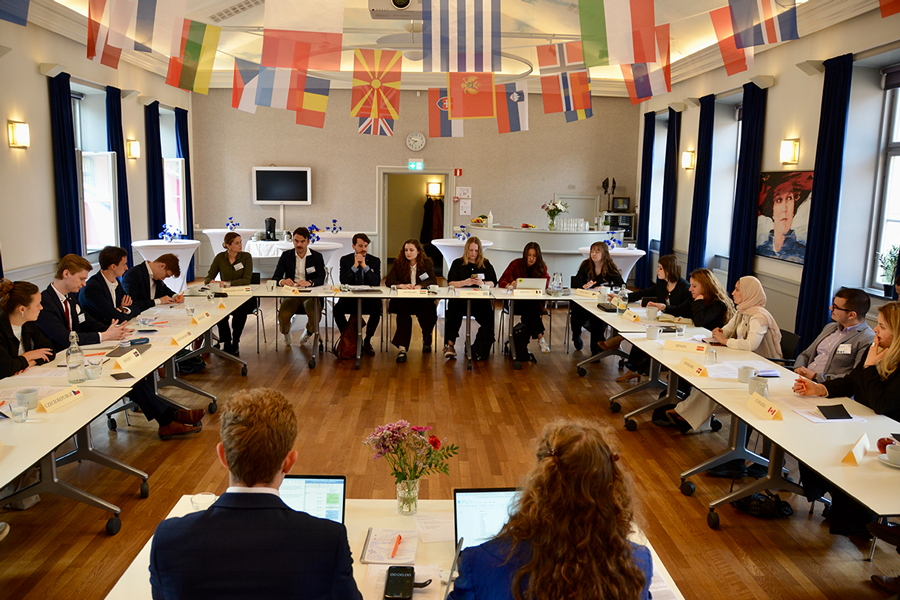
It took me and the association I’m currently vice-chairing four years of work and travelling all across Europe before sufficient momentum was gathered for government entities and businesses to notice, and now these have generously enabled our association to establish multiple legacy platforms that will engage hundreds of youths in Sweden and abroad. While these platforms, like conferences, seminars and delegations are not groundbreaking in themselves, the context in which we apply them – and the level of ambition that underpins them – most certainly is.
These ambitions would not be possible to realise if not for the support from actors of influence all across society. To engage and support enough youths to locally, regionally or even nationally strengthen democratic resilience demands government-level funding, speakers from prestigious think tanks and logistics and venues from equally prestigious academic institutions. The value of these critical enablers is hard to overestimate.
If this vital support were made available earlier, and on a broader scale, our and others’ potential to foster democratic resilience through these platforms could be far more fully realised. Allowing true democratic resilience to remain an abstract virtue is not merely a democratic shortcoming, but a strategic failure – one Europe can ill afford in an era defined by sustained global competition, systemic pressure, and contested international norms.
Aron Roosbergis Vice Chair of YATA Sweden, a Second Lieutenant in the Swedish Army, and abachelor’s student of political science. He has previously been engaged as aResearch Fellow at the EPIS think tank and is an alumnus of the New SecurityLeaders Program and the King’s Foundation for Young Leadership’s flagshipprogramme, Value-Based Leadership. He is actively involved in promotinginterest and participation among young people in security and defence policy.


You will find more information about our upcoming activities in our newsletter.

Register here for our newsletter!
